
Reviewed · JERUSALEM OLD CITY TOURS
Classic Jerusalem Old City Tour – Dguide Self Guiding App
Jerusalem’s Old City can feel like a maze, but this self-guided DGuide tour gives you a clear path through its major sights without tying you to a group or a fixed pace. Uri Goldflam, a professional guide and educator with 30 years of experience, created the route and its commentary.
I like two things right away: the $7 price makes this an easy way to add context to a day of sightseeing, and the app lets you linger at a church, take a detour, or skip ahead without holding anyone up. The main consideration is that you are on your own. You must manage the walking, stairs, crowds, opening hours, and extra admission fees.
Key points at a glance
- Jaffa Gate start: Begin at one of the Old City’s most useful entry points and get your bearings before entering the lanes.
- Eight historical stations: The route links the Tower of David, Mount Zion, the Roman Cardo, ancient waterworks, the Herodian Quarter, the Western Wall, and the Church of the Holy Sepulchre.
- Built for flexible pacing: The route takes about two to four hours, but you can pause, wander away, and return to the tour later.
- Two paid stops: Admission to the Tower of David Museum and the Wohl Archaeological Museum is not included.
- Strong historical range: You move from King Hezekiah’s era to Roman Jerusalem, the destruction of AD 70, and the major Christian and Jewish holy sites.
- Requires active walking: Expect stairs and a moderate level of physical effort, with the tour ending back at the starting point.
A $7 way to make sense of Jerusalem’s Old City

The Old City is compact, but it is not simple. A few minutes of walking can carry you from a medieval gate to a Roman street, from a Jewish prayer site to a church revered by Christians as the place of Jesus’ crucifixion and resurrection.
That is where this app earns its small price. You are not paying for a live guide, transport, or entrance tickets. You are paying for a prepared route and spoken or written interpretation that helps you understand what you are seeing.
At $7 per person, the value is strongest if you want structure but dislike being rushed. A traditional private guide can offer conversation and instant answers, but this costs far less and gives you control over the day. You can spend extra time at the Western Wall, walk slowly through the Christian Quarter, or pause the program while you find your way through the Old City lanes.
The app itself is free. After booking, you receive a coupon code in the Before You Go section of your confirmation email. You use that code to access this particular tour.
More walks through the Old City:
- Jerusalem: Guided Walking Tour of the Old City
★ 4.7 · 386 reviews - Best seller! Jerusalem old city four quarters tour
★ 5.0 · 123 reviews - Private Tour Jerusalem Old City
★ 5.0 · 118 reviews
Starting at Jaffa Gate

The tour begins at Jaffa Gate, one of the easiest Old City entry points for getting oriented. The opening station takes about 10 minutes and explains where you are before leading you inside.
I like this short introduction because Jerusalem’s Old City has several quarters, gates, lanes, and hills that can quickly blur together. Starting with a basic sense of direction helps you understand how the rest of the walk fits together.
Jaffa Gate is also a practical meeting point. It is near public transportation, and the tour is designed to end back there. Since the route includes several historic areas, you should still keep your phone charged and pay attention to the app’s directions.
Tower of David: history inside an ancient citadel
The second station is the Tower of David Museum of the History of Jerusalem. The museum occupies the ancient citadel, a fortified site that has watched over the city for centuries.
The planned visit is about an hour, making this the longest single stop on the route. You can expect historical displays set within the citadel itself, along with a 360-degree view of both the Old City and the modern city beyond it.
The location is also tied to the Christian story of Jesus. The tour points to what may have been the place connected with his trial. The wording matters: this is presented as a possible location, not a fact that can be proven beyond doubt.
Admission is not included. That changes the practical value of this stop. If you want the full museum experience, you will need to pay separately and allow enough time during its opening hours. If you prefer to keep the walk close to $7, you can use the app’s explanation and move on without entering.
Mount Zion and three important sites
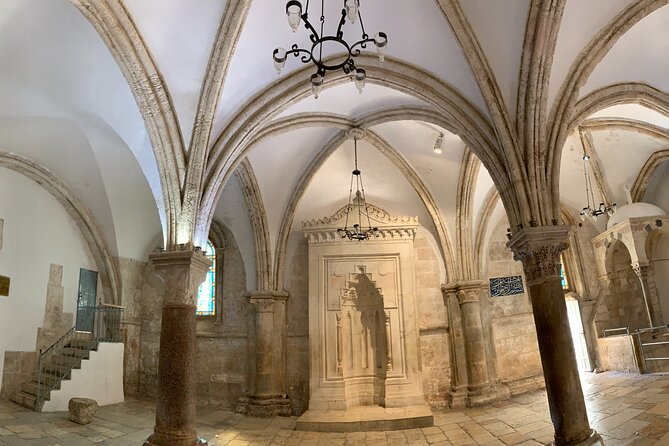
Next, the tour heads to Mount Zion for about 30 minutes. This station brings together the Dormition Abbey, the Upper Room, and the traditional site of King David’s tomb.
This is a useful example of how Jerusalem layers religious traditions in a small area. Christian and Jewish associations share the same hill, and the tour helps you see those connections rather than treating each site as an isolated stop.
The word traditional is important at King David’s tomb. Sacred sites in Jerusalem often carry centuries of belief and devotion, even when their exact historical identification cannot be proven. The app gives you a way to appreciate both the faith attached to a place and the limits of certainty.
The listed time is only 30 minutes, so you may need to move briskly if you want to see all three sites. You can also pause the tour and spend longer at the place that matters most to you.
A few more Jerusalem half-days to weigh up
- In The Footsteps of Jesus Day Tour – Dguide Self Guiding App
★ 4.5 · 3 reviews - From Tel Aviv: Dead Sea Self-Guided Chill-Out Day Trip
★ 4.2 · 64 reviews
Walking the Roman Cardo

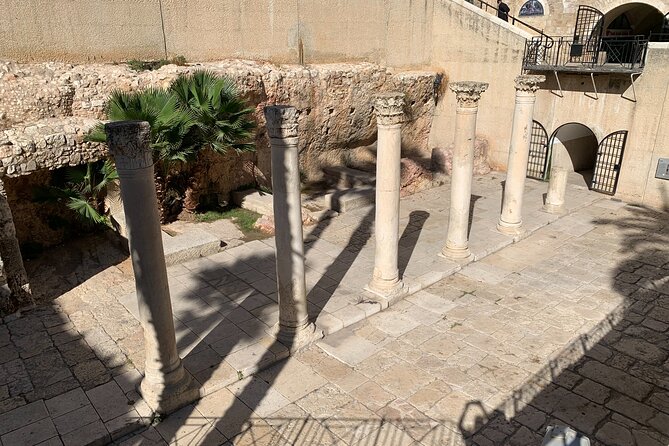
Another station takes you to the Roman Cardo, the main north-south street associated with Jerusalem rebuilt under Emperor Hadrian in the first half of the second century.
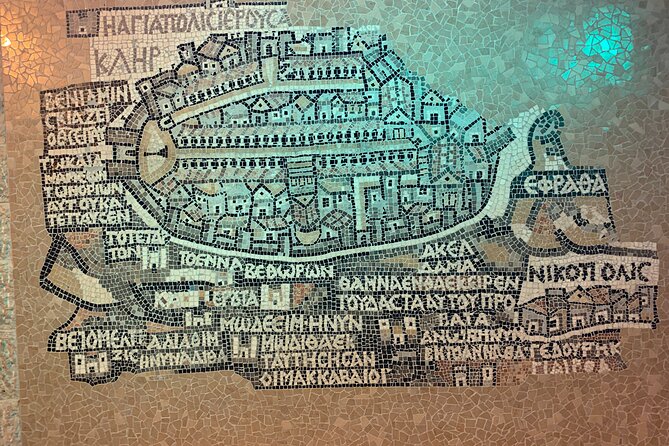
Here, you walk along Roman pavement and see a replica of the Madaba Map, one of the oldest known maps of Jerusalem. The original map is a sixth-century mosaic in Jordan, while the replica helps you understand how the city was represented in the Byzantine period.
This stop is valuable because it shifts your attention from holy sites to the physical city. Stones, street plans, and old building lines show how Jerusalem functioned as an urban center long after the biblical period.
You may find this station especially useful if you enjoy archaeology and city planning. If your main interest is pilgrimage, it provides a needed historical pause between the Christian and Jewish sites.
Ancient waterworks from the time of King Hezekiah
The route also includes a relic connected with Jerusalem’s biblical past and the time of King Hezekiah, about 2,700 years ago.
The supplied details do not name the exact feature, so you should use the app’s explanation for the full context. Its place in the route is clear: it connects the Old City you see today with the city described in the Hebrew Bible.
This station adds balance to the walk. You are not only following stories from the Roman and Christian periods. You are also being reminded that Jerusalem’s water supply and defenses were major concerns many centuries earlier.
Because the tour requires walking and stairs, take this section at a pace that feels comfortable. The app allows you to pause rather than forcing you to keep up with a group.
The Herodian Quarter and the evidence of AD 70
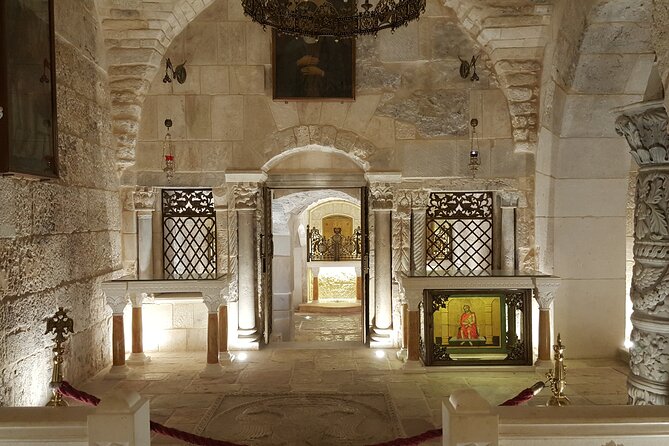
The Wohl Archaeological Museum, located in the Herodian Quarter, focuses on excavated homes from first-century Jerusalem. The station is planned for about 30 minutes.
Here, you see the remains of large residences, expensive decoration, and physical evidence of the city’s destruction by the Romans in AD 70. This can be one of the most revealing stops on the route because it makes the destruction personal and concrete. Instead of hearing only about a city falling, you see the scale of the homes and the wealth that once occupied them.
Admission is not included, so plan for another separate fee if you want to enter. You should also check the museum’s operating hours before building your day around it. The tour gives you the setting and the reason to visit, but the entrance cost belongs to you.
I like the contrast between this site and the Roman Cardo. The Cardo shows a later version of Jerusalem rebuilt under Roman rule. The Herodian Quarter shows the city before its destruction, when wealthy homes occupied this part of Jerusalem.
The Western Wall and the edge of the Temple Mount
The Western Wall is scheduled for about 20 minutes and is described as a remnant of the Temple in Jerusalem. It is the closest place to the Temple Mount where Jews can pray.
This stop is not mainly about looking at old stones. It is an active religious site, and you should approach it with respect. The short planned visit gives you time to understand its role and observe the setting, but you can use the flexible format to pause longer if you wish.
The app’s strength here is context. Without explanation, it can be easy to see the wall as one more ancient structure. With the historical background, you can better understand why this particular section matters so deeply to Jewish worship and memory.
The route’s mix of faiths also becomes clear here. The Western Wall and the Church of the Holy Sepulchre are not interchangeable sights, and the tour helps place each in its own religious and historical setting.
The Church of the Holy Sepulchre

The final major station is the Church of the Holy Sepulchre, planned for about 30 minutes. It occupies the traditional location of Jesus’ crucifixion and resurrection.
The church was first built in the fourth century and has undergone later rebuilding. That long process is part of what makes the site difficult to take in at first. It is not a single-period monument with one neat design. Its story includes the original church, later changes, and the continued importance of the place to Christian worship.
The DGuide format works well if you need time to look carefully. You can stop the commentary, study the setting, or continue when you are ready. You can also return to the route after stepping away.
The site may be the emotional center of the tour for Christian visitors, while the earlier stops provide essential historical framing. If you are not visiting for religious reasons, the church still offers a close look at how belief, architecture, and centuries of rebuilding overlap in Jerusalem.
How much time you really need
The official duration is about two to four hours. The difference depends on your pace, the time you spend inside the two museums, and how often you pause or leave the suggested path.
Two hours would require a fairly direct walk and limited time at the paid museums. Four hours gives you room to listen carefully, take breaks, and spend more time at the Tower of David Museum or the Wohl Archaeological Museum.
The app does not force you to finish in one continuous stretch. You can follow the route, wander off it, then return later. That is a major advantage in the Old City, where you may want to stop for food, shopping, prayer, or simply a rest.
The trade-off is that you must manage your own schedule. A live guide would notice if you were lost, tired, or eager to spend more time at one site. Here, you need to make those calls yourself.
Walking, stairs, and practical limits
This is not a sit-down sightseeing activity. You should have a moderate level of physical fitness and be ready for walking and stairs.
The Old City route covers several districts and historic sites, so comfortable footwear matters. Parking fees are not included, and arriving by public transportation is likely more practical since the starting point is near public transit.
The listed operating hours are Monday through Thursday, 8:00 AM to 5:00 PM, for the stated activity period. The two museums have their own admission rules and schedules, so do not assume that the app’s operating hours guarantee museum entry.
Because this is a mobile ticket, you need access to the app and the coupon code sent with your booking confirmation. Save the confirmation details before you begin, especially if your phone connection is not reliable inside thick stone buildings.
Who will get the most from this tour
I would choose this for independent visitors who want historical guidance without paying for a private live guide. It is also a good fit for couples, families with older children, and small private groups who prefer to set their own pace.
The tour suits you if you want a broad first look at Jerusalem’s Old City. It links Jewish, Christian, Roman, biblical, and archaeological sites instead of focusing on only one tradition.
It may not suit you if you want lively conversation, personal stories, or immediate answers from a guide beside you. Uri Goldflam is praised for being articulate, funny, accommodating, and highly informed in his work as a live guide, but this product is an app-based experience. Do not book it expecting Uri to walk with you in person.
The app also works best for people who are comfortable with phones and self-navigation. If you prefer someone else to handle timing, route choices, and entry decisions, a live walking tour may be worth the higher cost.
Cancellation and booking notes
You receive confirmation at the time of booking. Free cancellation is available if you cancel at least 24 hours before the local start time.
Cancellations or changes made less than 24 hours before the start time are not accepted for a refund. Keep that deadline in mind if your Jerusalem plans are still shifting.
Should you book the DGuide Old City tour?
Book it if you want an affordable, flexible introduction to Jerusalem’s Old City and are willing to walk independently. For $7, the route covers a remarkable range of places, from Jaffa Gate and the Roman Cardo to the Western Wall and the Church of the Holy Sepulchre.
I especially like it as a first-day orientation. You get the main historical framework, then you can return later to the site that caught your attention. Just budget separately for the Tower of David Museum and the Wohl Archaeological Museum, and do not confuse this self-guided app with a live tour led by Uri.
Skip it if you need personal assistance, dislike navigating by phone, or want a guide who can respond to questions in real time. For independent visitors, though, this is a low-cost way to put the Old City’s many layers into focus.
FAQ
How much does the Classic Jerusalem Old City Tour cost?
The tour costs $7 per person.
Is the DGuide app included?
The DGuide app is free. After booking, you receive a coupon code to access the Classic Jerusalem Old City Tour.
Where does the tour begin?
The tour begins at Jaffa Gate in Jerusalem’s Old City.
Where does the tour end?
The activity ends back at the meeting point.
How long does the tour take?
The tour takes about two to four hours, depending on your pace and how long you spend at each stop.
Are museum admission fees included?
No. Admission to the Tower of David Museum and the Wohl Archaeological Museum is not included.
Does the tour require much walking?
Yes. You should have a moderate level of physical fitness, and the route requires walking and using stairs.
Can I cancel for a full refund?
Yes, if you cancel at least 24 hours before the experience’s local start time. Cancellations or changes made less than 24 hours before the start time are not accepted for a refund.
Just added around Jerusalem
- Tel Aviv & Old City of Jaffa – Tiny group from Tel Aviv★ 4.5 · 9 reviews
- Tel Aviv; Jaffa Old City, Port & Shuk Hapishpishim Walking Tour★ 4.5 · 11 reviews
- Discover the Secrets of the Underground Jerusalem with a private tour★ 5.0 · 4 reviews
- Private Tour : Jerusalem Old City Day Trip from Tel Aviv★ 5.0 · 19 reviews
- Private Tour from Tel Aviv to Jerusalem★ 5.0 · 3 reviews
- Luxury Private Tour to Jerusalem from Tel Aviv★ 5.0 · 22 reviews
- Tel Aviv Airport (TLV) to Jerusalem Hotels – Private Transfer★ 4.0 · 19 reviews
- Palm Sunday in Jerusalem: Mass at Bethpage and Via Dolorosa Procession with Transport from Tel Aviv★ 5.0 · 3 reviews
Jerusalem Old City Tours, compared.






City of David and Underground Jerusalem Day Tour
Read our review →
Browse the lists this tour appears in