
Reviewed · GUIDED
Jerusalem Guided Tour from Tel Aviv
Jerusalem packs several thousand years into a walkable day. This tour takes you from the food stalls of Mahane Yehuda Market to the Western Wall, Temple Mount, Via Dolorosa, and Church of the Holy Sepulchre, with a guide to explain what you are seeing rather than leaving you to decode the stones alone.
I like the mix of sacred landmarks and ordinary city life, especially the market stop and the walk through the Jewish Quarter. I also like the strong value at $66, with the guided tour and return transport to Tel Aviv included. The tradeoff is pace: ten and a half hours sounds generous, but fourteen stops leave little room for lingering.
Five things to know before booking
- Mahane Yehuda comes early: You get time for produce, spices, baked goods, cafes, and market atmosphere before the Old City walk.
- The day covers three major faith traditions: The Western Wall, Temple Mount, Dome of the Rock, Al-Aqsa Mosque, Via Dolorosa, and Church of the Holy Sepulchre all appear on the route.
- The Temple Mount schedule can change: It is closed to visitors every Friday, Saturday, and during various Muslim and Jewish holidays, when a viewing point replaces the visit.
- The Old City portion is mostly on foot: Expect narrow lanes, historic streets, religious sites, and a steady amount of walking.
- Return transport is included, but the outbound trip is not: Meet at HaHagana Rail Station in Tel Aviv at 9:00 a.m., then return to Abraham Tel Aviv on HaRakevet Street.
A long Jerusalem day for $66
At $66 per person, this is priced as an efficient introduction to Jerusalem rather than a slow, specialist tour. You are paying for a full day with a guide, admission to the Hurva Synagogue, and transport back to Tel Aviv. Food, drinks, and your journey to the starting point are extra.
I consider that fair value if this is your first Jerusalem visit and you want the main sights organized in one day. The tour removes much of the guesswork from a city where religious sites have strict rules, access can change, and the Old City’s lanes are easy to misread.
The group can reach 34 people. That is large enough to keep the price down, but it may feel less personal than a private guide or a small walking tour. Pay attention to the guide’s position and stay close at busy points, especially around the market and Old City entrances.
The 10-hour-30-minute schedule includes transportation and the full sightseeing route. You should think of it as a survey course: useful, lively, and packed with landmarks, but not designed for sitting quietly at each site.
A few more Tel Aviv half-days to weigh up
- From Tel Aviv: Jerusalem Old & New City Bus Tour
★ 4.2 · 824 reviews - Jerusalem: Guided Walking Tour of the Old City
★ 4.7 · 386 reviews - Full Day City Tour of Jerusalem
★ 4.1 · 367 reviews
Starting at Davidka Square and Mahane Yehuda
The day begins at Davidka Square, a useful meeting point near the market, Jaffa Road pedestrian mall, and Jerusalem’s light rail station. The square takes its name from the Davidka, a homemade mortar used by Jewish forces during the 1948 Arab-Israeli War.
You get about 15 minutes here. That is enough to get oriented and hear why this ordinary-looking public square carries a wartime name, but it is not a major sightseeing stop in itself.
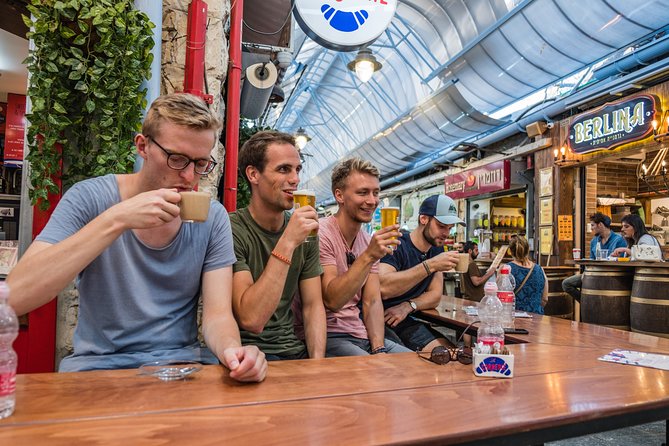
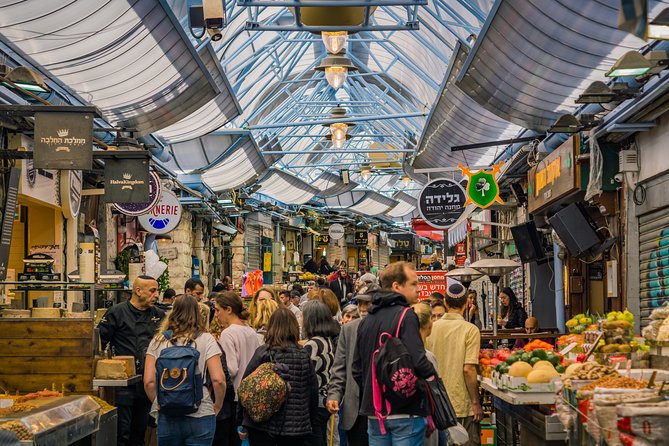
The next 90 minutes belong to Mahane Yehuda Market, also called the Shuk. This is one of the best choices on the route because it gives you a taste of present-day Jerusalem before the day turns toward ancient walls and holy places.
Expect stalls filled with produce, spices, baked goods, and other food items. The market also has cafes, restaurants, and bars, so it is more than a place to buy groceries. If you want lunch or snacks, this is one of the few points where food is part of the setting rather than an afterthought.
Food and drinks are not included, so bring money for anything you want to sample. Keep your expectations sensible: the schedule allows a good walk through the market, not an extended food tour with time at every counter.
Jaffa Gate and the edge of the Old City
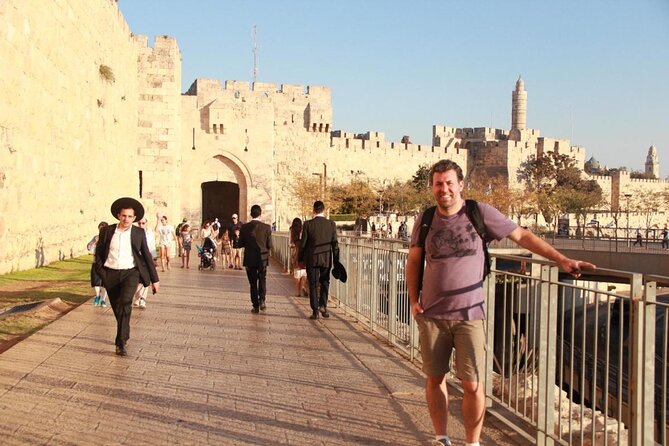
Jaffa Gate is the natural gateway into the Old City’s Christian and Armenian quarters. Its name points toward Jaffa, the port city on the Mediterranean, and its location has made it an important meeting place for centuries.
The tour allows 30 minutes here. You will get a chance to see the gate, understand its role as an entrance, and prepare for the tighter streets ahead.
The nearby Tower of David receives only 15 minutes. This ancient fortress has served military and political rulers for more than 2,000 years, including Herod, the Crusaders, the Ottomans, and the British.
The Tower of David now houses a museum with exhibits on Jerusalem from ancient times to the present. Admission is not included, and the short stop is mainly for the exterior and the setting. If you want the museum, ramparts, or panoramic views, plan a separate visit on another day.
That short timing is a recurring theme. You will see the city’s headline attractions, but you will not have the freedom to explore every museum, chapel, roof, and courtyard at length.
The Jewish Quarter, Cardo, and Hurva Synagogue

The route continues through the Jewish Quarter, where the Cardo offers a clear look at the city beneath the modern streets. This Roman avenue was built during the reign of Emperor Hadrian in the second century and once served as a commercial center lined with shops and public buildings.
You get about 15 minutes. Look for the original Roman columns and the reconstructed Byzantine-era shops. It is a compact stop, but the Cardo helps connect Jerusalem’s modern streets to its Roman and Byzantine periods.
The Hurva Synagogue gets 30 minutes and is the main included admission on this part of the route. The synagogue was first built in the early eighteenth century, destroyed during the 1948 war, and rebuilt from its original plans after a major restoration effort began in 2000.
Its domed roof and decorated interior make it one of the Jewish Quarter’s most striking buildings. More important, the site gives your guide a chance to explain Jewish life, loss, rebuilding, worship, and community in Jerusalem without reducing the quarter to a set of old stones.
This is one place where a guide adds real value. The buildings are impressive, but the sequence of destruction and rebuilding is what gives the visit weight.
Same part of the country, a completely different day out:
- Tel Aviv Jaffa Guided Bike Tour
★ 4.5 · 178 reviews - 2 Day Tour to Petra and Wadi Rum from Tel Aviv
★ 4.0 · 154 reviews - Day Tour to Petra by Bus from Tel Aviv
★ 3.5 · 149 reviews - Carmel Market Tasting Tour – LocaLocal
★ 5.0 · 140 reviews
Seeing the Western Wall from above and below
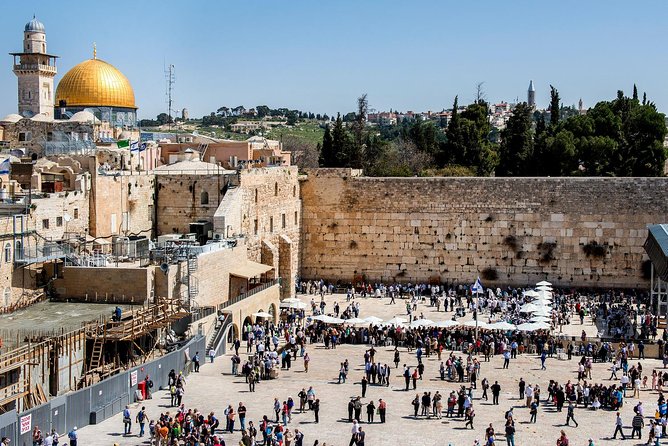
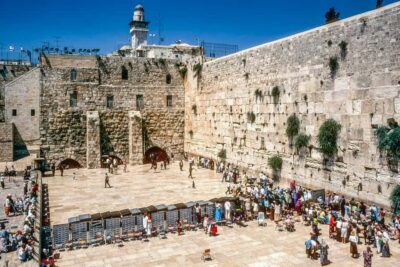
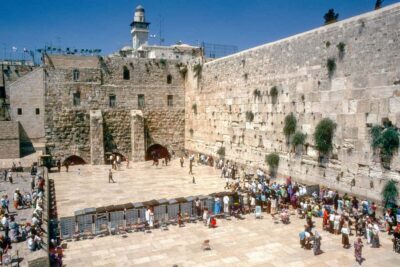
The Western Wall Observation Deck provides a wider view of the Wall and Temple Mount before you go down to the prayer plaza. You have about 15 minutes at the viewpoint, followed by 30 minutes at the Western Wall itself.
The Western Wall is the last remaining section of the retaining wall associated with the Second Temple, destroyed by the Romans in 70 CE. It is Judaism’s holiest prayer site, and people come to pray, touch the stones, and place written prayers in the cracks.
The observation point matters because the Wall can feel like an isolated plaza when seen only from ground level. From above, you can better understand its place within the Old City and its close relationship to the Temple Mount.
Expect a respectful atmosphere. This is an active place of prayer, not simply a photo stop. Your guide can explain the setting, but you should also allow people space to worship.
The 30-minute visit is enough to see the area and absorb its importance. It is not enough for an unhurried personal visit if you want to pray, reflect, or explore nearby sections on your own.
Temple Mount, the Dome of the Rock, and Al-Aqsa
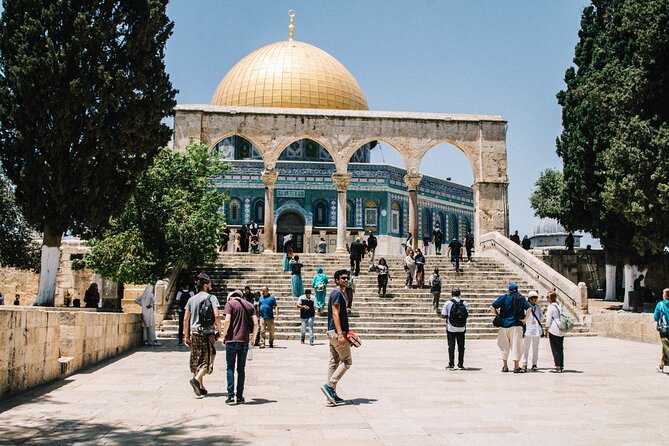
Temple Mount is the most sensitive and changeable part of the day. It is sacred to Jews, Christians, and Muslims, and it is home to the Dome of the Rock and Al-Aqsa Mosque.
The tour allows 30 minutes at Temple Mount, 15 minutes for the Dome of the Rock, and 15 minutes for Al-Aqsa Mosque. Non-Muslim visitors can view the outer courtyard of the Dome of the Rock, but access to its interior is restricted to Muslims. Al-Aqsa also has dress codes and site rules.
The Dome’s golden roof and decorated exterior are among Jerusalem’s most recognizable sights. Even from outside, the building’s tile work, mosaics, and position above the Old City make this a worthwhile stop.
Access is not guaranteed on every departure. Temple Mount, including the Dome of the Rock and Al-Aqsa Mosque, closes to visitors every Friday and Saturday and during various Muslim and Jewish holidays. When that happens, the tour includes a viewpoint overlooking the mount instead.
This is not a minor detail. Check the date before booking if seeing the complex up close is central to your plans. The viewpoint still gives you a memorable view, but it is not the same as entering the compound.
Walking the Via Dolorosa
The Via Dolorosa is traditionally identified as the route Jesus followed toward crucifixion. The path includes fourteen stations marking events such as his condemnation, falls, crucifixion, and burial.
You get about 30 minutes on the route. That is enough for an introduction and several key points, but not for a detailed pilgrimage through every station. The streets are narrow, and the route is part of the living Old City rather than a quiet museum corridor.
This is where the guide’s storytelling matters most. Without context, the Via Dolorosa can feel like a confusing set of alleys and chapels. With a good explanation, the route becomes a way to understand Christian devotion, the shape of the Old City, and the layers of worship that occupy the same small area.
You should wear comfortable shoes and expect uneven streets. The tour covers a lot of ground, and the religious stops require attention to local rules and customs.
Church of the Holy Sepulchre
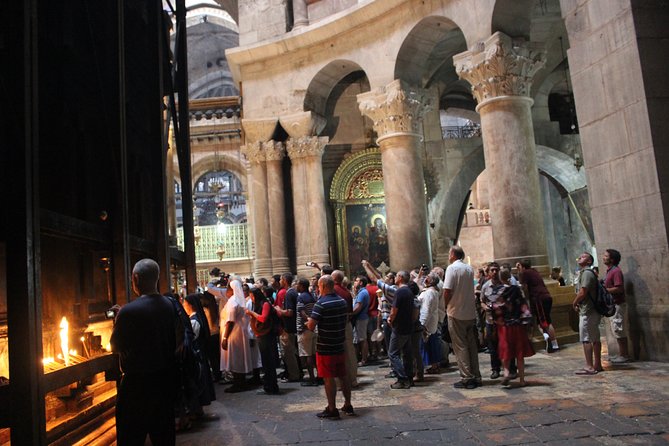
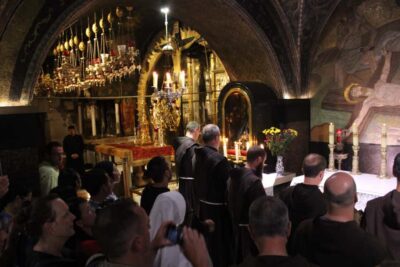
The Church of the Holy Sepulchre receives about 30 minutes. Christians regard it as the place of Jesus’ crucifixion, burial, and resurrection, making it one of the most important pilgrimage sites in the world.
The church has been destroyed and rebuilt several times since its first construction in the fourth century. Inside, you may see chapels, mosaics, domes, carvings, and the places associated with the Tomb of Christ.
Thirty minutes gives you a meaningful first look, but the church can be complex to understand. Several Christian traditions share responsibility for the building, and the interior contains many chapels and sacred points. You may need to follow the guide closely so you do not miss the main sections.
I like that the tour places the church after the Via Dolorosa. The sequence gives the visit a clear religious story instead of treating the church as an isolated monument.
Ending in the Old City Bazaar
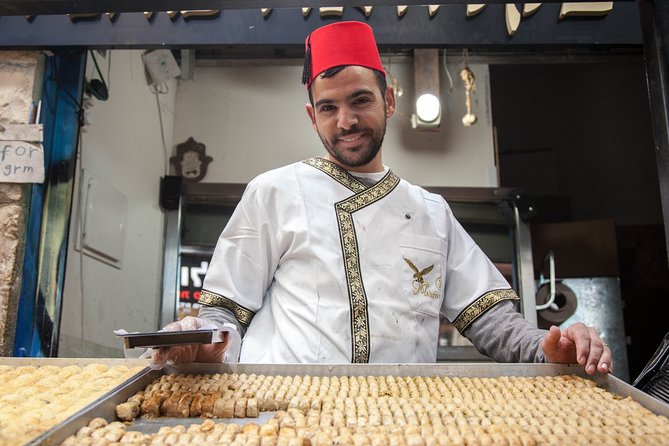
The final 30-minute stop is the Old City Bazaar, a maze of stalls selling spices, textiles, jewelry, souvenirs, and local food. It is a good place to finish because the bazaar brings together the city’s commercial and social life after a day focused on sacred sites.
You can browse, sample local foods, and practice bargaining. Do not expect a relaxed shopping session if the group must leave on schedule. Use the time to look around and get your bearings, then save serious shopping for a return visit.
The bazaar also gives you a final look at Jerusalem as a lived-in city. The Old City is not only a collection of holy places. It is also a network of shops, homes, workshops, and daily routines.
Guides, group size, and the day’s pace
The guide can make or break a full-day Jerusalem tour. A guide named Shahar is specifically praised for clear explanations and for taking care of the group. That is the sort of leadership this route needs, since the day moves between Jewish, Christian, and Muslim sites with little spare time.
The maximum group size is 34. You may get a lively mix of questions and viewpoints, but you should not expect the quiet attention of a private tour. Stay near the guide, especially at Jaffa Gate, the market, and the bazaar.
The start time is 9:00 a.m. at HaHagana Rail Station in Tel Aviv. Return transport is provided to Abraham Tel Aviv at HaRakevet Street 8. The information does not include outbound transportation, so you need to arrange your own way to the meeting point.
Confirmation arrives when you book, and the tour is near public transportation. Most people can participate, but the amount of walking and the historic streets make comfortable footwear a smart choice.
Free cancellation is available up to 24 hours before the start time for a full refund. Changes or cancellations inside that window are not accepted, and poor weather or failure to reach the minimum group size can lead to a different date or a full refund.
Who should book this Jerusalem tour?
I would choose this tour if you have one open day from Tel Aviv and want to see Jerusalem’s essential sights without planning every transfer and entrance yourself. It is especially useful for a first visit, since the guide links the sites and keeps the day moving.
You will get the most from it if you enjoy history, religious places, city walking, and a busy schedule. The mix of Mahane Yehuda, the Jewish Quarter, the Western Wall, Temple Mount, the Via Dolorosa, and the bazaar gives you a broad first impression.
I would hesitate if you want long visits at museums, extended time for prayer, or a slow food-focused day. The Tower of David, Church of the Holy Sepulchre, and Temple Mount all deserve more time than this schedule can provide.
Should you book it?
Book this Jerusalem tour if value, structure, and coverage matter most. For $66, you receive guided sightseeing across the Old City, an included Hurva Synagogue entrance, and transport back to Tel Aviv, with Mahane Yehuda adding a welcome taste of local life.
Before booking, check the date for Temple Mount access and be ready for a long walking day. If you accept the brisk pace, this is a practical way to see Jerusalem’s major religious landmarks and still sample the city beyond its sacred stones.
FAQ
How long is the Jerusalem tour from Tel Aviv?
The tour lasts approximately 10 hours and 30 minutes.
What time does the tour start?
The start time is 9:00 a.m.
Where does the tour begin?
The meeting point is HaHagana Rail Station in Tel Aviv-Yafo.
Where does the tour end?
Return transportation ends at Abraham Tel Aviv on HaRakevet Street 8, Tel Aviv-Yafo.
Is transportation from Tel Aviv included?
Transportation back to Tel Aviv is included. Transportation to the starting point is not included.
Is food included in the price?
No. Food and drinks are not included.
Is the Tower of David entrance included?
No. The Tower of David stop does not include admission.
Is admission to the Hurva Synagogue included?
Yes. Admission to the Hurva Synagogue is included.
Can visitors enter the Dome of the Rock?
Non-Muslim visitors may visit the outer courtyard, but access to the interior is restricted to Muslims.
What happens if Temple Mount is closed?
Temple Mount, including the Dome of the Rock and Al-Aqsa Mosque, is closed to visitors every Friday, Saturday, and during various Muslim and Jewish holidays. The tour then includes a viewpoint overlooking Temple Mount.
Just added around Tel Aviv
- Private wine tour of Northern Israel★ 5.0 · 4 reviews
- Package VIP Skip Line Services in BGN Airport with Transfer to Tel aviv Hotels★ 5.0 · 3 reviews
- Israel Holy Land Christian Tour Package 7 days – Private Tour Package★ 5.0 · 31 reviews
- VIP Tel Aviv airport Terminal 3 Fast Track Skip Line From plane★ 4.5 · 9 reviews
- Tel Aviv and Jaffa Most Exciting Private Tour★ 4.5 · 13 reviews
- Food & Drink Private Guided Tour in Tel Aviv★ 5.0 · 3 reviews
- Urban Walking & Food Tour in Tel Aviv★ 5.0 · 7 reviews
- Tel Aviv & Jaffa Urban Bike Expedition★ 5.0 · 33 reviews
Guided, compared.
Travel to Bethlehem Half Day Guided Tour from Jerusalem & TelAviv
Read our review →
Travel To Bethlehem, Jericho & Jordan River – Group Guided Tour from Jerusalem
Read our review →
Browse the lists this tour appears in