
Reviewed · JERUSALEM TOURS
Jerusalem: Dual Narrative Tour
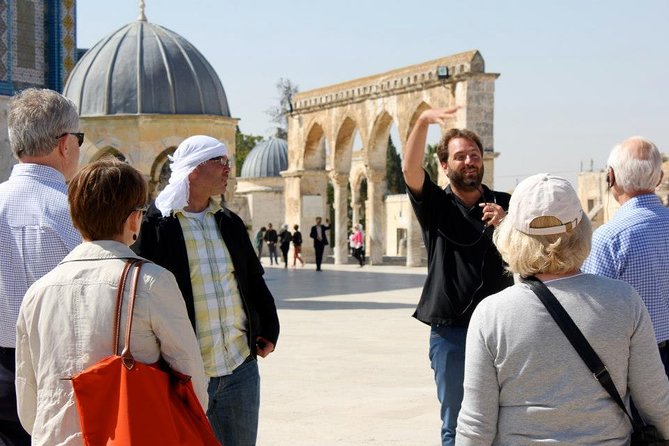
Jerusalem is not a city with one story. This four-and-a-half-hour walking tour puts two voices beside you, one Jewish and one Palestinian, as you move through the Old City’s sacred quarters. The striking part is not just seeing the Western Wall, Holy Sepulchre, and Al Aqsa Mosque. It is hearing how the same stones carry different meanings.
I like the dual guide format, especially when the guides respectfully explain where their views differ. I also like that the tour gets beyond famous monuments to discuss borders, excavations, signs, renamed spaces, and recent tensions.
The main drawback is the pace. There are no included food or drink breaks, and the route can feel hot, tiring, and fast. You need modest clothing, water, sun protection, and enough energy for several hours on foot.
Key things to know before booking
- Two guides, two narratives: A Jewish guide and a Palestinian guide explain Jerusalem’s religious and political disputes from their own backgrounds.
- Nine major stops: The route includes Jaffa Gate, the Armenian and Jewish quarters, the Holy Sepulchre, Muslim Quarter, Via Dolorosa, Western Wall, and Al Aqsa.
- A serious look at contested space: You discuss what lies beneath the Roman Cardo, how borders are presented, and why the Noble Sanctuary remains a flash point.
- Strong value at $65: For a small group capped at 20 people, the price covers two professional guides and a host across a long morning of discussion.
- Dress and stamina matter: Knees and shoulders must be covered, and you should bring water, a hat, and comfortable walking shoes.
- Best for curious first-time visitors: This suits you if you want context and discussion, not simply a quick procession past the sights.
Why the two-guide format works in Jerusalem
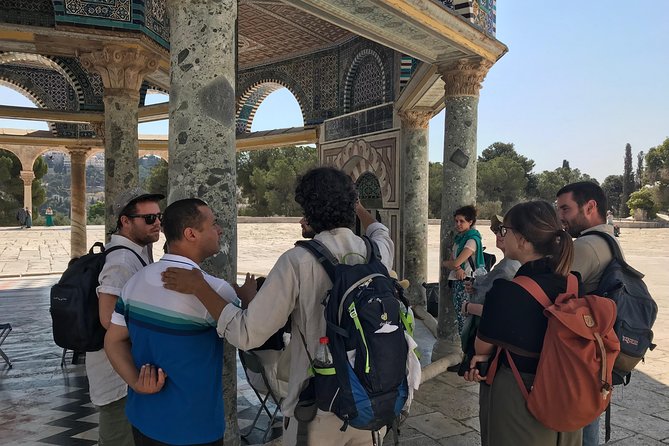
Most Old City tours move from one sacred building to the next. This one asks you to pay attention to the story wrapped around each place. A Jewish guide may explain the connection between modern Jewish life and earlier periods of Jerusalem’s past. A Palestinian guide may add how the same spaces fit into Palestinian identity, Muslim tradition, or present-day restrictions.
That does not make the tour perfectly neutral. No serious account of Jerusalem can erase personal background or political position. The value is that you hear the guides explain their own points of view openly, while keeping the exchange civil. The strongest feedback about this format centers on the guides’ respect for one another, direct answers, and willingness to take questions.
Several guide pairs have led the tour, including Betty and Ameer, Morgi and Amir, Nour and Alex, and Beni and Yousef. Your guides may be different. The important point is the structure: two professional guides, two lived perspectives, and one shared route through the Old City.
You should come ready for difficult subjects. The tour covers Israeli and Palestinian claims, religious traditions, changes to public spaces, and the conflict surrounding Jerusalem. If you want only architecture and ancient stories, this may feel too political. If you want to understand why a doorway, sign, wall, or plaza can carry so much weight, it offers unusual value.
A few more Jerusalem half-days to weigh up
- From Tel Aviv: Jerusalem Old & New City Bus Tour
★ 4.2 · 824 reviews - Jerusalem: Guided Walking Tour of the Old City
★ 4.7 · 386 reviews - Full Day City Tour of Jerusalem
★ 4.1 · 367 reviews
Jaffa Gate: start with the city’s basic geography
Meet at 9:30 a.m. in the plaza just outside Jaffa Gate. Look for a representative holding a Jerusalem: Dual Narrative Tour sign. This is a sensible starting point because the gate gives you a quick orientation to the Old City and the surrounding geography of Israel and Palestine.
The opening question is pointed: what does a sign at the entrance tell you about the ruling power that put it there? That question sets the tone for the morning. You are not only learning where the quarters sit. You are considering how governments use names, symbols, and public signs to present their claim to a place.
Allow about 20 minutes here. It is also a good moment to ask practical questions about the route, since the morning involves several changes in direction and a fair amount of standing.
The Armenian Quarter and the Roman Cardo
The Armenian Quarter receives a short but worthwhile stop. You look at signage commemorating the Armenian genocide and discuss Armenian identity in Jerusalem. This is an easy community to overlook when attention is fixed on the city’s three major faiths, so the stop widens your view of who has made a home here.
The visit lasts about 10 minutes. It is brief, but it helps explain why Jerusalem cannot be reduced to a simple Jewish, Christian, and Muslim triangle.
In the Jewish Quarter, the Roman Cardo opens another question: how does modern Israel connect Jewish life today with earlier periods in Jerusalem? You examine the excavated street and discuss what lies below the current surface. The key issue is not just the Roman columns or the age of the stones. It is the process of excavation itself, including which layers were removed and which past is made most visible.
This is one of the tour’s most useful habits. You learn to look at archaeology as a choice, not just a neutral window into the past. Plan on about 20 minutes here.
St Mark’s Syriac Church and the rooftop view
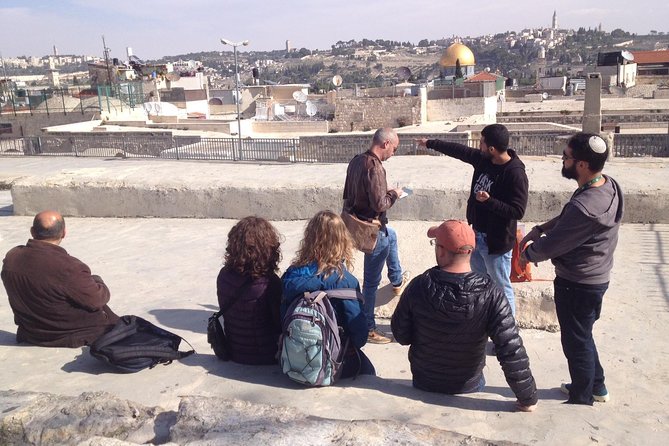
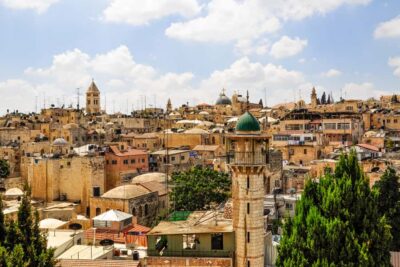
At St Mark’s Syriac Church, the tour stops above the church at a rooftop with a view toward East Jerusalem. The focus shifts from individual buildings to the city’s edges and major landmarks.
You review Jerusalem’s borders and use the view to place the Old City in a wider setting. This is valuable after the close lanes of the first quarters, since it gives you a chance to connect the city’s physical layout with the political divisions being discussed.
The stop is only about 10 minutes. Do not expect a long rooftop visit or a leisurely photo session. Still, the change in viewpoint helps you understand why maps and sightlines matter so much here.
Same part of the country, a completely different day out:
- Old and New Jerusalem Day Trip from Tel Aviv
★ 4.5 · 296 reviews - Old and New Jerusalem Full-Day Tour
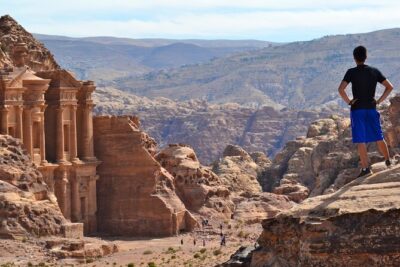
★ 4.0 · 273 reviews - 2-Day Petra Tour from Jerusalem
★ 4.5 · 212 reviews - Jerusalem Half-Day Sightseeing Tour
★ 3.9 · 177 reviews
The Holy Sepulchre: one church, many claims
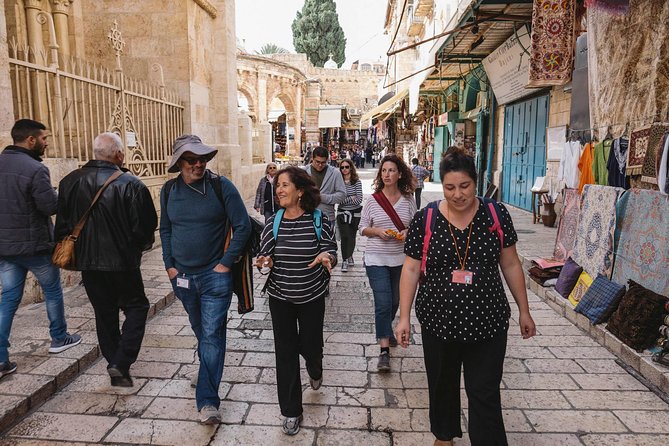
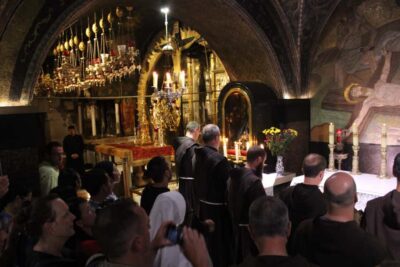
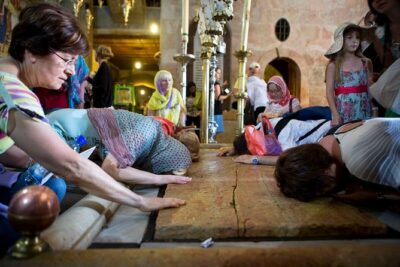
The Church of the Holy Sepulchre is allotted about 30 minutes. You learn why the church is central to Christian tradition and how it fits into Israeli and Palestinian accounts of Jerusalem. The guides also take you to major places within the church itself.
This is one of the tour’s most important stops, but it is not designed as a detailed church visit. The building is complicated, crowded, and divided among several Christian communities. You may not have time to wait in every line or study each chapel at length.
That tradeoff is worth understanding before you book. The tour gives you context for the Holy Sepulchre and shows you its major areas, but if your main goal is to visit the tomb associated with Jesus or spend a long time inside, plan a separate return visit. The same advice applies to walking every station of the Via Dolorosa.
The Muslim Quarter and the Via Dolorosa
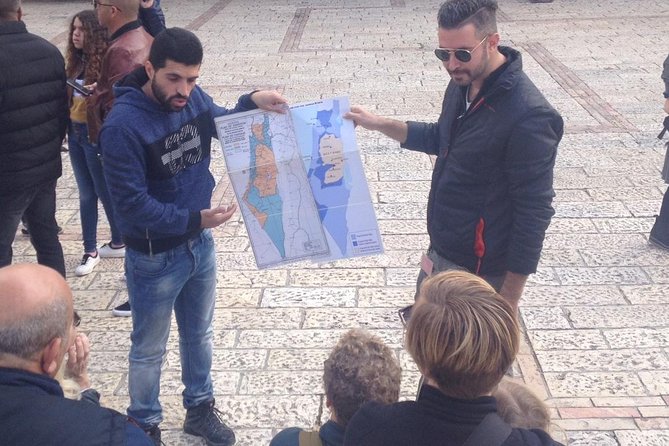
The route continues through the Muslim Quarter, where you discuss the communities of the Old City, their links with the wider Muslim world, and current tensions. The quarter is not treated as a backdrop for the more famous holy places. It becomes part of the story in its own right.
After about 15 minutes in this section, the tour moves along the Way of the Cross, or Via Dolorosa. The planned conclusion is near the Fifth Station of the Cross and the Austrian Hospice, with final reflections and time for questions.
Here again, the exact experience depends on crowding and the pace of discussion. One account of the tour found that the Via Dolorosa received less attention than expected because the group had spent so much time on other topics. That is a useful warning. This is a discussion-led tour, so the route may not give you a slow, complete walk through every station.
The Austrian Hospice is also listed as the meeting end point, at Via Dolorosa Street 37. Confirm the day’s precise walking order with your guides, especially if you have another booking afterward.
The Western Wall and Al Buraq Square
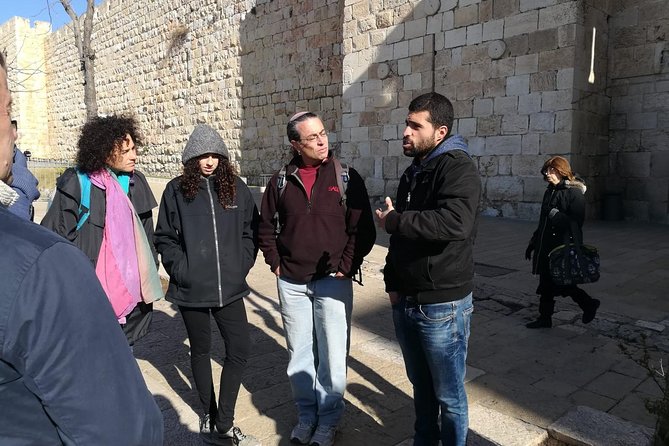
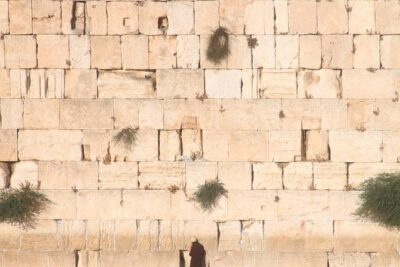
At the Western Wall, you enter the Western Wall and Al Buraq square after passing through Wadi Road. The guides explain the Second Temple and the long Jewish tradition of pilgrimage to the remains. You also hear about Al Buraq and the Islamic account of Muhammad’s flight to Jerusalem.
The point is not to force one interpretation over another. It is to show why the same area has such strong meaning in Jewish and Muslim traditions. You also discuss how the open complex looked before and after Israel captured the area more than 50 years ago.
This section lasts about 25 minutes. It is a good example of the tour’s method: first the sacred meaning, then the historical development, then the political changes that altered the space around it.
You should expect security and crowds around major holy sites. Large electronics are not permitted, so pack light and avoid bringing bulky equipment. The tour does not include transportation to or from the Old City, food, or drinks.
Al Aqsa and the Noble Sanctuary
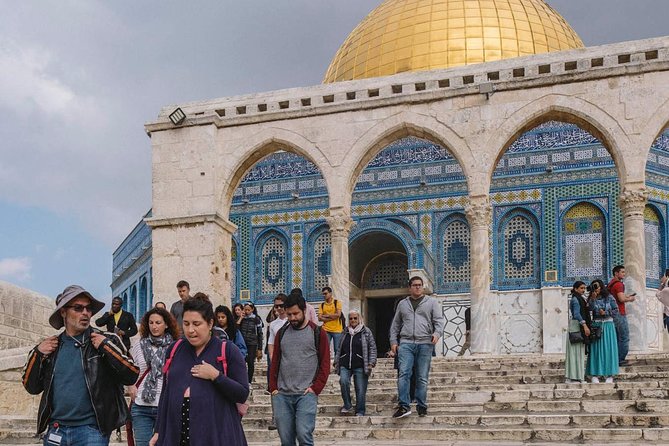
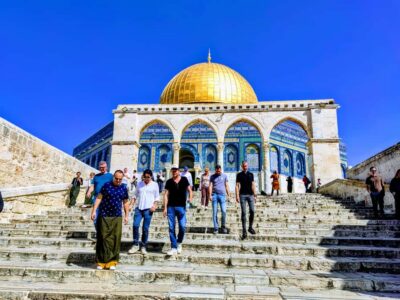
The longest stop is the Temple Mount and Noble Sanctuary complex, with about an hour devoted to the site. You view the tiled Dome of the Rock and Al Aqsa Mosque while learning why this platform matters to Jews, Christians, and Muslims.
The tour focuses on the central question: why is this place such a flash point between Israelis and Palestinians? That discussion connects religious belief with access, sovereignty, public control, and competing claims to the same ground.
This is also the part of the morning where patience matters most. Rules for entering places of worship can be strict, and conditions can change. The supplied information confirms the major sights covered, but it does not promise entry into every interior space or access to every part of the compound.
Dress carefully. Men and women must cover shoulders and knees, and shorts or sleeveless tops are not allowed. A light long-sleeved shirt and loose trousers or a long skirt make the morning easier. Bring a hat and plenty of water, since the tour takes place outdoors for much of its length.
What $65 buys you
At $65 per person, this is not the cheapest way to walk around the Old City. You can see many exterior sights on your own without paying an admission fee. The value here comes from the time and structure: two professional guides, a tour host, a group capped at 20 people, and sustained discussion at the places where the city’s stories collide.
The dual format matters financially, too. You are not paying for two unrelated guides. You are paying for a planned exchange between two perspectives across a single route. That is hard to reproduce by reading a guidebook or joining an ordinary monument-focused walk.
I would call the price fair for a first visit if you want political and religious context. It is less attractive if you mainly want interior visits, long photo stops, or a relaxed pace. The tour covers a great deal in four and a half hours, so some stops are necessarily short.
The tour is booked about 25 days ahead on average. That suggests you should reserve early if your Jerusalem dates are fixed, especially since the group is limited to 20 people. Confirmation is provided when you book, and the mobile ticket is convenient for meeting at Jaffa Gate.
The physical effort and practical details
You need a moderate level of fitness. The route includes steady walking through Old City lanes, standing at crowded sites, and time outdoors. There is no included meal break, so eat before the 9:30 start and carry water. If you need a snack, do not assume the group will pause long enough for one.
The most useful packing list is simple:
- Water and a hat
- Comfortable walking shoes
- Clothing that covers shoulders and knees
- A mobile phone with your ticket available
- Minimal electronics and a small bag
Service animals are allowed, and the meeting point is near public transportation. You arrange your own way to Jaffa Gate and from the end point. Free cancellation is available until 24 hours before the local start time. If the minimum number is not met and the tour is canceled, you are offered another date or experience, or a full refund.
Who should book this tour?
I would choose this for a first or early visit to Jerusalem, particularly if you want help making sense of current tensions rather than simply collecting famous sights. It suits people who ask questions, listen closely, and can handle disagreement without needing a single tidy answer.
Families with older children may find it useful, but the political material is serious and the pace is demanding. People with limited mobility, low heat tolerance, or a strong need for regular meal breaks should think carefully before booking.
I would not make this your only visit to the Holy Sepulchre or the Via Dolorosa. Use the tour to understand the places, then return later for a slower look at the interiors and devotional details.
Should you book the Jerusalem Dual Narrative Tour?
Book it if you want context at the exact places where religious belief and political power meet. The strongest feature is the respectful exchange between the Jewish and Palestinian guides, supported by clear explanations and open questions.
Skip it if you want a quiet sightseeing walk, a leisurely meal break, or a detailed visit inside every holy site. At $65, the tour earns its price through its two voices and serious discussion, not through exclusive access.
For most curious first-time visitors, I think it is a smart way to begin Jerusalem. Just arrive rested, dress properly, carry water, and leave room in your schedule to revisit the sites that deserve more time.
FAQ
How long does the Jerusalem Dual Narrative Tour last?
The tour lasts approximately four hours and 30 minutes.
What time and where does the tour start?
It starts at 9:30 a.m. at Jaffa Gate in Jerusalem’s Old City. Look for a representative holding a Jerusalem: Dual Narrative Tour sign in the plaza just outside the gate.
Where does the tour end?
The stated end point is the Austrian Hospice at Via Dolorosa Street 37, Jerusalem.
Who leads the tour?
The tour is led by two professional guides, one Jewish and one Palestinian, along with a tour host or escort.
Which major sites are included?
The route covers Jaffa Gate, the Armenian Quarter, the Jewish Quarter and Roman Cardo, St Mark’s Syriac Church, the Church of the Holy Sepulchre, the Muslim Quarter, the Via Dolorosa, the Western Wall, and Al Aqsa Mosque within the Noble Sanctuary complex.
What should I wear?
You must cover your shoulders and knees. Shorts and sleeveless tops are not allowed when entering places of worship and selected museums. This rule applies to men and women.
Is food included?
No. Food and drinks are not included unless specifically stated, and the tour does not provide transportation to or from the attractions.
Can I cancel for a refund?
You can cancel up to 24 hours before the experience starts for a full refund. Cancellations or changes made less than 24 hours before the start time are not accepted for a refund.
Just added around Jerusalem
- Tel Aviv & Old City of Jaffa – Tiny group from Tel Aviv★ 4.5 · 9 reviews
- Tel Aviv; Jaffa Old City, Port & Shuk Hapishpishim Walking Tour★ 4.5 · 11 reviews
- Discover the Secrets of the Underground Jerusalem with a private tour★ 5.0 · 4 reviews
- Private Tour : Jerusalem Old City Day Trip from Tel Aviv★ 5.0 · 19 reviews
- Private Tour from Tel Aviv to Jerusalem★ 5.0 · 3 reviews
- Luxury Private Tour to Jerusalem from Tel Aviv★ 5.0 · 22 reviews
- Tel Aviv Airport (TLV) to Jerusalem Hotels – Private Transfer★ 4.0 · 19 reviews
- Palm Sunday in Jerusalem: Mass at Bethpage and Via Dolorosa Procession with Transport from Tel Aviv★ 5.0 · 3 reviews
Jerusalem Tours, compared.
Browse the lists this tour appears in